Meta Breaks Ground on Alberta Data Centre in Sturgeon County
Meta announced a CAD 13 billion investment to build its first Canadian data centre, a 1 GW AI-optimized campus in Sturgeon County, Alberta, aimed at…
 Par
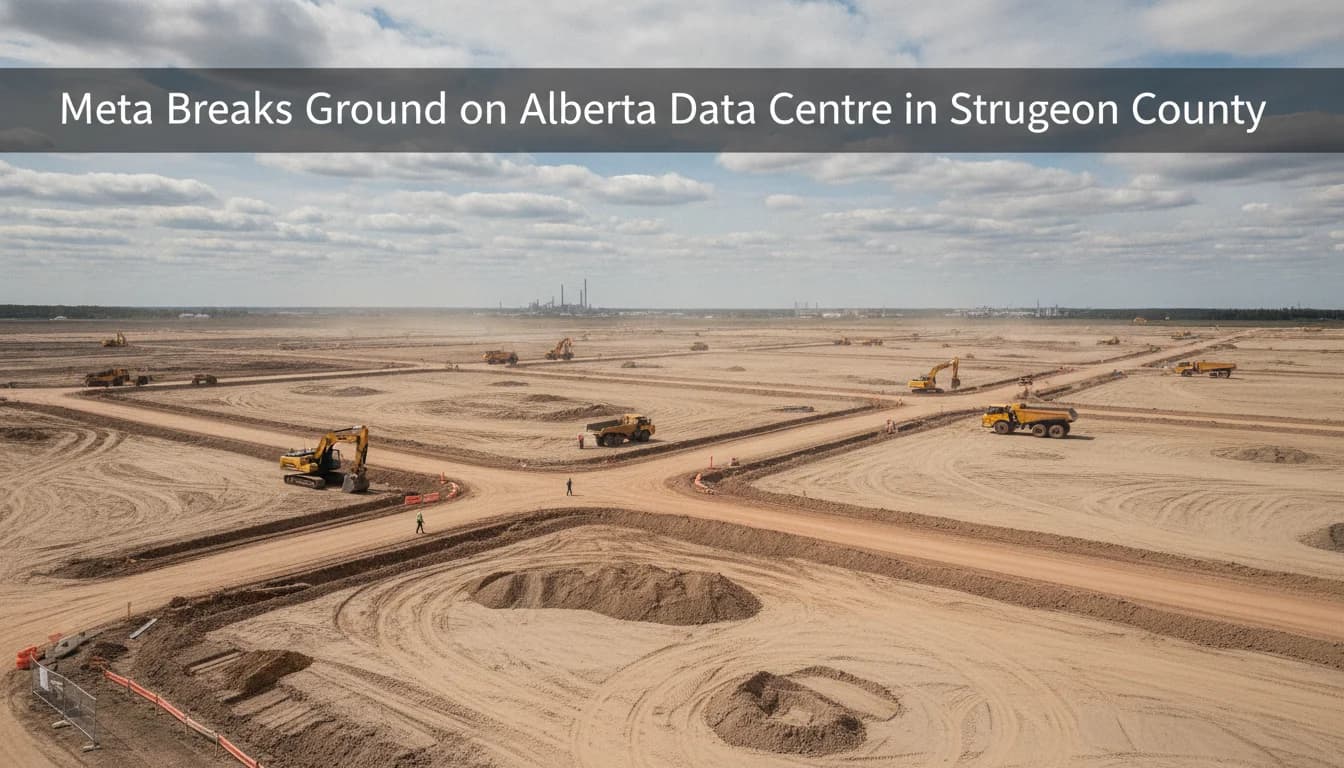
On July 8, 2026, Meta announced it would invest CAD 13 billion to build its first Canadian data centre, a 1 GW AI-optimized campus in Sturgeon County, Alberta. This is the moment that Meta says will anchor Canada’s foray into large-scale AI infrastructure, placing Alberta at the center of a rapidly expanding hyperscale compute ecosystem. The announcement, made by Meta’s Canada-focused communications team in partnership with provincial and local officials, frames the development as a long-term commitment to AI-enabled services, local job creation, and a package of public-private investments designed to upgrade the regional grid and surrounding infrastructure. The company’s stated plan includes not only the data centre itself but also downstream infrastructure investments and community programs aimed at broadening the regional tech ecosystem. The event was covered by multiple outlets and corroborated by provincial and municipal sources, underscoring the scale and significance of Meta’s Alberta project for the national AI strategy. This news matters because it signals a high-stakes convergence of private capital, energy infrastructure, and data-driven workloads that will shape Alberta’s economy for years to come. It also signals Canada’s broader push to attract global hyperscale players and the accompanying regulatory and environmental considerations that come with such projects. For readers tracking AI infrastructure, energy policy, and regional development, the CAD 13 billion data centre in Sturgeon County marks a watershed moment in Canada’s technology landscape. See Meta’s official announcements for direct details on scope and timelines. Breaking Ground on Meta’s First Data Center in Canada and Hello, Sturgeon County! provide primary statements of record; the Alberta government’s Major Projects registry confirms the investment scale and associated power generation plans. (about.fb.com)
What Happened
Announcement Details and Project Scope
In a coordinated release on July 8, 2026, Meta disclosed that it would construct its first Canadian data centre campus in Alberta's Sturgeon County, just north of Edmonton. The project is described as a 1 GW AI-optimized facility designed to support Meta’s expanding AI workloads and core services, including potential impacts on its social media platforms and related products. The release from Meta’s Canada newsroom emphasizes that the Sturgeon County campus will be the company’s 33rd data centre globally and its first in Canada. The company projects a total investment exceeding CAD 13 billion, with construction employment peaking at roughly 3,000 workers and ongoing operations supporting more than 300 permanent roles. The announcement also notes CAD 60 million in local infrastructure investments—covering roads and water systems—to accompany the data centre’s development. For the community, Meta also signals a program of annual Data Center Community Action Grants to support local nonprofits. The company highlights a water-efficient cooling approach designed to minimize operational water use, aligning with its broader sustainability commitments. The primary source text confirms the 1 GW capacity, CAD 13 billion investment, 3,000 construction jobs, 300 ongoing jobs, CAD 60 million in infrastructure, and the planned annual grants. The release explicitly describes the location as Sturgeon County, Alberta, and frames the project as the company’s first data centre in Canada. See the official post for detailed takeaways. (about.fb.com)
Timeline and Key Milestones
- July 8, 2026: Meta publicly breaks ground on its first Canadian data centre, a 1 GW AI-optimized campus in Sturgeon County, Alberta, with a CAD 13 billion investment and thousands of local construction jobs; the company additional details surface about local infrastructure investments and community grants. This is the foundational milestone for Meta’s Canadian footprint. (about.fb.com)
- July 8, 2026: Meta posts a companion update detailing the project’s scope, including the declaration that the data centre will use a closed-loop cooling system and will be powered by new, private energy generation designed to minimize water use and maximize reliability on the Alberta grid. The same post notes the planned contribution to local roads and water infrastructure and outlines ongoing engagement with provincial and municipal partners. (datacenters.atmeta.com)
- Early 2030s (projected): A power-generation partner—Greenlight Electricity Centre, a 932 MW natural-gas facility—begins operations, forming the adjacent energy backbone referenced by provincial briefings and industry outlets. This timeline aligns with publicly shared energy-compatible planning around the Alberta data centre cluster. While timelines vary by source, multiple outlets and government summaries corroborate the connection between data-centre growth and new generation capacity. (apnews.com)
Key Facts and Figures at a Glance
- Location: Sturgeon County, Alberta, north of Edmonton
- Capacity: 1 gigawatt (1 GW) data centre
- Investment: CAD 13 billion (private investment)
- Jobs: ~3,000 construction roles at peak; 300+ operational positions
- Infrastructure: CAD 60 million allocated to local roads and water systems
- Water strategy: Closed-loop cooling with dry cooling to minimize water use
- Energy strategy: Fully funded new generation and grid upgrades to support the data centre’s electricity needs The official communications emphasize a tightly choreographed deployment of infrastructure, manpower, and environmental safeguards designed to ensure the project integrates with the province’s energy and water policies. The primary sources lay out these details in parallel: the Meta press release and Meta’s Sturgeon County post. For the public record, Alberta’s Major Projects registry also confirms the CAD 13 billion figure and the associated energy infrastructure project accompanying Meta’s campus. (about.fb.com)
What the Local and Provincial Partners Say
Meta’s engagement with Alberta’s technology and innovation ministry, Invest Alberta, and local contractors is a central thread in the announcements. The company frames the investment as a catalyst for broader regional growth, an assertion echoed by provincial officials who describe the project as a landmark for Alberta’s AI and data-centre strategy. Alberta’s government materials stress the importance of major projects in driving growth, with the Meta project described as the largest AI data centre investment in Canadian history and a model for the bring-your-own-power framework the province has championed. This context is reinforced by Invest Alberta’s public summaries that position Meta’s CAD $13 billion campus as a key anchor for Canada’s AI compute ambitions. For readers who want the official, non-editorial framing, see the project page on Alberta’s Major Projects registry and Invest Alberta’s project overview. (majorprojects.alberta.ca)
What It Means for Stakeholders
- For Meta: The Alberta campus represents a flagship international data-centre asset designed to scale AI workloads and accelerate the company’s core services, while serving as a testing ground for new energy and water stewardship approaches in a jurisdiction actively courting hyperscale infrastructure.
- For Alberta: The project signals a deepening commitment to AI-driven economic development and diversification of energy-intensive industries, accompanied by the need to coordinate generation capacity and transmission upgrades with private investment to maintain grid reliability. The government’s materials emphasize a combination of private capital and public infrastructure improvements, underscoring a broader policy aim to attract large-scale compute while mitigating environmental and community impacts.
- For Local Communities: The project promises thousands of construction jobs in the near term and hundreds of ongoing jobs thereafter, alongside targeted community grants. Stakeholders will be watching road, water, and utility upgrades for measurable improvements in local services.
- For Energy Markets: The closely linked Greenlight Electricity Centre, a 932 MW natural-gas plant, is positioned as a critical enabler for Alberta’s data-centre ambitions, illustrating a model where data-centre growth aligns with new generation rather than competition with existing capacity. The arrangement is expected to influence regional gas demand and transmission planning, with potential ripple effects for local suppliers and contractors. (datacenters.atmeta.com)
Why It Matters (Broader Context)
The Meta data centre Alberta project sits at a nexus of technology leadership, energy policy, and regional economic strategy. It reflects a broader trend of hyperscale operators seeking jurisdictions with stable regulatory frameworks, access to reliable energy, and a readiness to support large-scale compute. In Canada and specifically Alberta, the government has actively shaped a policy landscape designed to attract AI-focused data-centre investment, including “bring-your-own-power” rules and targeted infrastructure support. The Alberta AI Data Centres Strategy and related government messaging position the Meta project as a benchmark for private capital mobilization in service of AI compute needs, while also emphasizing environmental stewardship and water conservation. This strategic backdrop is essential to understand Meta’s approach to Alberta—where the company’s scale and the province’s policy instruments converge to redefine the region’s digital economy. For policy framing and official context, consult Alberta’s AI data-centres materials and the major-project registry. (alberta.ca)
A Balancing Act: Perspectives and Trade-offs
- Economic Growth vs. Community Burden: Proponents argue the project will deliver long-term economic gains, improved infrastructure, and new opportunities across the supply chain. Critics raise questions about water use, energy demand, and potential strain on local services, requiring robust oversight and transparent reporting. Alberta’s own materials acknowledge the need to balance private investment with public infrastructure investments, aiming to mitigate local impacts through targeted funding and ongoing community engagement. This tension is a common feature of large-scale data-centre developments and is a central theme for readers tracking the finer points of implementation. (alberta.ca)
- Energy Strategy Alignment: The project’s energy plan—combining private generation with grid upgrades—illustrates a notable shift in how data-centre power is procured and delivered. The stance is consistent with Alberta’s push to diversify generation capacity while maintaining grid reliability, a policy approach that other provinces and countries are watching as a potential blueprint for similar investments. Industry observers will be looking for performance metrics on energy efficiency, demand management, and the integration of renewable energy where feasible. (about.fb.com)
- Environmental Stewardship: Meta emphasizes a water-efficient cooling approach and a broader commitment to water stewardship with a 2030 target to be water-positive globally. The practicality of such goals depends on ongoing reporting and verification, which the company commits to making publicly available. Readers should monitor annual sustainability disclosures and independent assessments to gauge progress toward these commitments. (datacenters.atmeta.com)
What’s Next (Timeline and Next Steps)
Construction Timeline and Milestones
- Early 2026–2027: Detailed construction planning and procurement steps proceed, with local contractors Frost Collective (a Clark Builders and PCL Construction joint venture) involved in the project’s execution. The primary announcements emphasize ongoing engagement with construction partners and a transparent approach to project scheduling. The timing of groundbreaking events in mid-2026 sets the stage for multi-year construction activity. (datacenters.atmeta.com)
- 2028–2030: The adjacent Greenlight Electricity Centre is expected to come online, delivering the dedicated generation capacity required to support the data centre’s energy needs and reinforcing the province’s energy strategy aligned with private compute investments. Reports and official summaries suggest a late-2030 completion window for the power plant, aligning with infrastructure timelines for ensuring reliable power to the data centre complex. Readers should watch provincial updates for any changes in the schedule as regulatory processes and permitting advance. (apnews.com)
- 2030s and beyond: Long-term operational milestones will include the achievement of operational jobs targets and ongoing community support programs tied to the Data Centre Community Action Grants. These programs are designed to maintain a constructive, ongoing relationship with the Sturgeon County community and to amplify the social value generated by the project. (about.fb.com)
What to Watch For
- Regulatory Milestones: Given the scale of the project and Alberta’s regulatory environment for energy, water, and land use, expect periodic updates on environmental monitoring, grid integration, and local infrastructure improvements. The Alberta Major Projects registry provides a formal portal for tracking such milestones, and ongoing government communications are likely to detail any adjustments to timelines or commitments. (majorprojects.alberta.ca)
- Economic Impact Assessments: Local and provincial agencies will monitor economic indicators tied to the project, including job creation, supplier opportunities, and tax/levy receipts. Alberta’s official materials emphasize the broader economic spillovers beyond the immediate construction phase, including opportunities for local businesses and the region’s supply chain. Stakeholders should seek annual updates to quantify these impacts more precisely as the project progresses. (alberta.ca)
- Environmental and Community Metrics: Meta’s own disclosures and third-party assessments (including public sustainability reporting) will be key to understanding water usage, energy efficiency, and community outcomes. The company’s public commitments to water stewardship and transparency with operations set expectations for ongoing data sharing. (datacenters.atmeta.com)
What's Next
Follow-up Steps for Stakeholders
- Local governments and communities should prepare for ongoing engagement with Meta, ensuring channels for feedback, oversight, and partnership programs stay open. The company’s community-grants program, announced as part of the Sturgeon County project, is a focal point for local nonprofit organizations seeking to leverage benefit from the investment. Readers should track announcements from the Data Centre Community Action Grants program for opportunities and reporting on funded initiatives. (datacenters.atmeta.com)
- Energy and Grid Coordination: Expect continued coordination between Greenlight Electricity Centre, Altalink, Capital Power, and the Alberta Electric System Operator as the generation and transmission infrastructure advances. This coordination is essential to maintain grid reliability given the large, multi-staged energy demand of the data centre and its adjacent facilities. Government and industry briefings will likely provide updated timelines and capacity plans as the project unfolds. (about.fb.com)
- Regulatory and Environmental Oversight: Ongoing reporting and independent assessments will be critical to validating the project’s environmental commitments, especially with respect to water use and habitat protections in the North Saskatchewan watershed. Meta’s stated approach to closed-loop cooling and water stewardship will be scrutinized as part of this oversight. (datacenters.atmeta.com)
Potential Benchmarks to Watch
- Construction Milestones Met: The pace of site preparation, permitting, and the progression of major build phases will serve as a tangible gauge of the project’s momentum and the region’s capacity to support hyperscale infrastructure.
- Power-Plant Synchronization: The timing of the Greenlight Electricity Centre’s operation will be a critical determinant of the data centre’s on-time commissioning and reliability metrics. The alignment between data-centre completion and new-generation capability will be a focal point for energy planners and market watchers.
- Community Impacts: Local economic indicators, school partnerships, and non-profit engagement outcomes from the Data Centre Community Action Grants will provide a measure of how the investment translates into tangible social capital in Sturgeon County and the wider Industrial Heartland. (sturgeoncounty.ca)
Closing
Meta’s Alberta announcement marks a milestone in Canada’s digital infrastructure story, situating a 1 GW AI-optimized data centre in Sturgeon County at the heart of a broader energy and policy framework designed to attract hyperscale compute. The CAD 13 billion investment and the accompanying energy and infrastructure commitments demonstrate the scale at which Alberta intends to compete for AI-driven data workloads, while the project’s governance—through Meta’s own disclosures and Alberta’s Major Projects registry—offers a transparent record of the commitments, timelines, and community benefits involved. For readers seeking to stay informed, follow Meta’s official Canada announcements, Alberta’s AI data-centres program updates, and local government communications from Sturgeon County and Invest Alberta as construction progresses. This story will continue to unfold over coming years as the data centre comes online and the adjacent generation and grid upgrades begin to deliver on the promised capacity and reliability improvements. (about.fb.com)